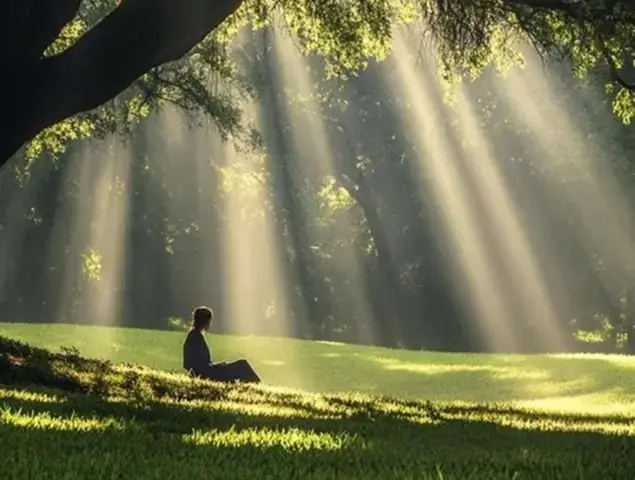
There is a word in Sanskrit - swa. It means oneself.
Not “alone.” Not “isolated.” Not “in a room with the door closed.” Just oneself. The self that is present, unedited, not performing for anyone.
When you trace solitude back through language, this is where it lands. The Latin solus, from which we get solitude, solitary, solo - most etymologists stop there. But some go further and connect solus to the Proto-Indo-European root - swo-, meaning “oneself.” And in Sanskrit, that same root shows up as swa.
That small connection changes everything about how we understand solitude.
What We Got Wrong About Solitude
Most of us grew up with solitude as a prescription. You need alone time. Schedule it. Protect it. The introvert’s lifeline, the spiritual seeker’s practice, the burnout cure. Go somewhere quiet, close the door, and recharge.
The problem with this framing is that it treats solitude as a condition - something that exists only when others are absent. So, we wait for it. We carve out time for it. And when life doesn’t cooperate, when the kids are home and the phone won’t stop and the day is relentless - we assume we lost access to it.
But if solitude is really about Swa - about being yourself - then the presence or absence of other people does not make a difference.
The Noise That Actually Breaks Solitude
You can be completely alone and have no solitude at all. Sitting in a quiet room, replaying a conversation from three days ago, rehearsing what you should have said, worrying about what someone thinks of you - that is not solitude. That is a crowd of projected voices with no one physically present.
And the reverse is also true. You can be in a full room - family, noise, conversation - and be completely in swa. Present as yourself. Not managing how you are coming across. Not calculating what is needed from you. Not shrinking or performing or waiting to be seen a certain way. Just there, as you are.
That is solitude. That is swa. That is Shūnya.
What actually breaks solitude is not the presence of people. It is the moment you start orienting yourself around how you are being perceived. The small internal shift in which your attention moves from what is actually happening in you to how you appear to someone else. That is where solitude ends.
Why This Matters More Than You Think
There is a reason the contemplative traditions - the forest monks, the cave yogis, the desert fathers - all prescribed solitude as a prerequisite for depth. But the solitude they were pointing to wasn’t just geographic isolation. It was the withdrawal of attention from external reference.
The Sufi practice of khalwa - formal seclusion - was about dissolving the ego’s reliance on the world to confirm its sense of self. Ramana Maharshi’s entire pointing was inward because you cannot see clearly when your attention is constantly moving outward, reading the room.
What they were really asking was: can you be yourself without needing the environment to reflect that back to you? Can you stay in Swa without external confirmation?
While scheduling alone time can be helpful, especially during the initial days of the journey towards self, the real practice is to find and be in the Swa at any given moment. Being yourself in every moment, whether anyone is watching or not.
Solitude as a Moment-to-Moment Possibility
When solitude is reframed this way, it stops being something you have to find. It becomes something you can inhabit - or lose - in any given moment.
You are in solitude when you are cooking - not narrating it to an imagined audience, not performing competence for yourself, just present with what is in your hands. You are in the Swa, in a meeting, when you respond from what you actually think rather than what will land well. You’re in solitude mid-conversation when something lands, and you let it land, without managing your reaction first.
None of that requires a closed door.
You lose solitude when the internal audience shows up - the part of you that is watching yourself, editing in real time, adjusting based on imagined perception. That is not always conscious. It can be a background hum you barely notice. But it is exactly what separates you from swa.
The Relationship Between Solitude and Depth
Here is something worth sitting with: what you can offer in any situation - in a conversation, a creative act, a moment of guidance, a relationship - is directly proportional to how much of yourself you actually know.
Not knowledge in the accumulative sense. Not information, training, or technique. The kind of knowing that only comes from being present with yourself long enough, consistently enough, that you stop being a stranger to your own experience.
Solitude - in the context of swa - is what makes that possible. Every time you return to yourself in the middle of a moment, every time you catch the drift toward performance and come back to what’s actually true in you, you are building that depth. Not as a project. Just as a consequence of being present.
This is why the traditions weren’t romanticizing isolation for its own sake. They understood that what you bring to life - the quality of your presence, your discernment, your capacity to hold and respond to what’s real - changes when you stop outsourcing your sense of yourself to external reference.
You Already Know This
There are moments, probably more than you track, when you are fully in swa. When you say something, and it comes from somewhere unedited. When you make a decision, and it’s clean - no second-guessing the audience, no calculating the reception. When you’re absorbed in something, the self-monitoring just goes quiet.
Those are not accidents. That is what it feels like to be yourself. That’s solitude - not as an event you scheduled, but as a quality of presence you slipped into.
The question isn’t how to find more time alone. It is about how to bring more of that quality into every moment you are already in.
Solitude was never about the room. It was always about whether you were in it.